China Top Pet Food Packaging Manufacturers? This question deserves more than a supplier list. Pet Food Packaging must protect nutritional quality, control odors, resist grease, and survive long-distance transport. It also shapes how shoppers judge freshness on a crowded shelf. A strong manufacturer should offer dependable materials, accurate printing, stable sealing, and practical customization. Food-grade compliance matters. So do traceability, factory hygiene, testing records, and honest communication.
Walter Soroka, a respected packaging educator and author, describes packaging as “the science, art, and technology of enclosing and protecting products.” That definition fits pet food closely. A stand-up pouch may need a high-barrier film against oxygen and moisture. A paper bag may require reinforced stitching around a 15-kilogram load. A metal can needs reliable seams and corrosion control. Small details often decide whether a product arrives clean or damaged.
This guide will examine China’s leading Pet Food Packaging manufacturers through production capability, material options, quality systems, export experience, and design support. It will consider flexible pouches, woven bags, cans, trays, and recyclable alternatives. Supplier claims should not be accepted blindly. Factory photos can look impressive, yet performance data may remain unclear. That is an uncomfortable gap. Buyers should request samples, technical specifications, audit evidence, and test results before making decisions. Prices also need context. A cheaper package can create higher costs through leakage, returns, or wasted product. The strongest choice is rarely the most attractive quote. It is the manufacturer that consistently protects the food, supports the brand, and admits where its solution still needs improvement.
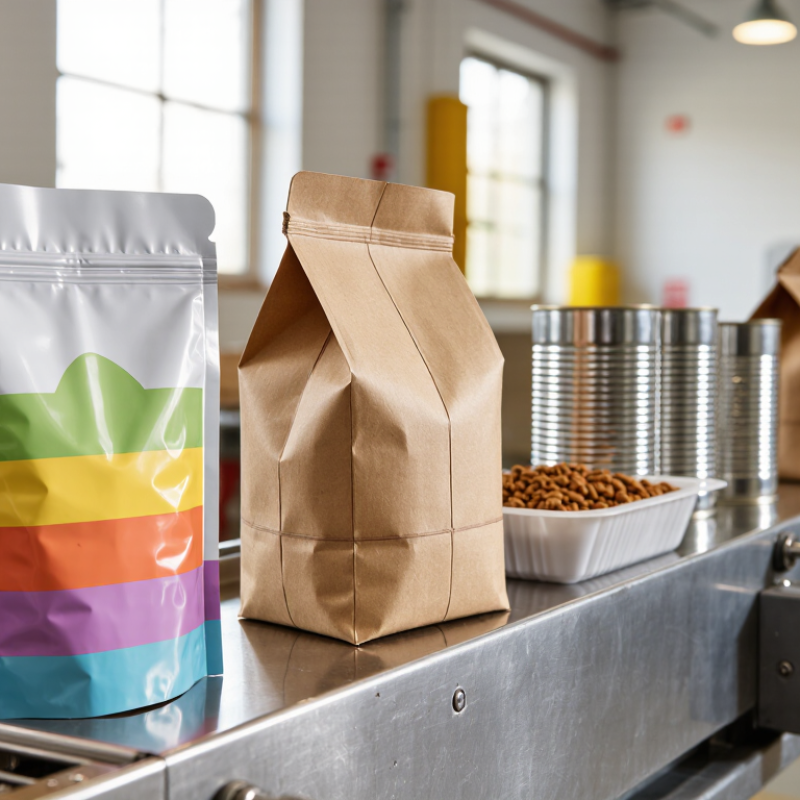
Chinese manufacturers produce pet food packaging in several practical formats. Flexible stand-up pouches are common for dry food, treats, and small trial portions. Their gussets help bags remain upright on retail shelves. Zippers support repeated opening, while tear notches improve daily convenience. Some factories add high-barrier films to reduce oxygen, moisture, and light exposure. Material selection depends on fat content, shelf life, and filling temperature. A shiny surface looks attractive, but appearance cannot replace barrier testing.
Flat-bottom bags suit larger kibble volumes and offer stable shelf display. Paper-touch laminates create a natural appearance, although they often need plastic layers for reliable sealing.
For wet food, manufacturers make retort pouches, aluminum trays, and plastic cups with heat-sealed lids. Retort structures must tolerate high temperatures without losing seal strength. Cans remain useful for long shelf storage and transport protection. They require accurate coating control when recipes contain acidity or salt.
Chinese packaging plants also make spouted pouches, sachets, sample packs, and recyclable mono-material options. Spouts help measure liquid supplements, but caps can complicate recycling. Mono-material designs may simplify recovery, yet they can sacrifice stiffness or oxygen protection. I would request migration data, seal-strength results, and odor checks before approving production. Factory samples are not enough. Ask for batch records and filling-line trials. Small defects often appear after transportation, not inspection. Packaging should match pet use, warehouse humidity, and the actual distribution route.
China’s leading pet food packaging suppliers combine material knowledge with practical factory experience. They commonly produce stand-up pouches, flat-bottom bags, cans, and recyclable films for dry and wet food. Strong suppliers show clear specifications for barrier layers, seal strength, printing accuracy, and food-contact safety. Their teams should explain oxygen transmission, moisture resistance, and storage performance in simple terms.
Reliable manufacturers also provide controlled sampling before mass production. A useful sample should include a working zipper, clean seals, readable batch areas, and realistic filling tests. Suppliers with professional quality systems can share inspection records, material certificates, and traceability details. However, paperwork alone cannot prove performance. I would still test filled bags under heat, pressure, and transport conditions. Small leaks often appear only after rough handling.
Tips: Ask for a complete material structure and thickness chart. Request samples from the actual production line. Check whether the package stands upright after filling. Confirm minimum order quantities, lead times, and inspection procedures in writing. Sustainable options may reduce plastic use, but they can affect stiffness, sealing, or shelf life. Discuss these compromises early. A supplier may offer an attractive design, yet the first version may feel too thin or difficult to open. That is not failure; it is useful feedback for the next test.
China Top Pet Food Packaging Manufacturers?
Materials and Technologies Used in Pet Food Packaging
Pet food packaging now balances oxygen control, shelf appeal, and waste reduction. Flexible pouches often use multilayer films with polyethylene, polyester, or aluminum foil. These layers block moisture, light, and oxygen. Rigid cans rely on steel or aluminum, while trays commonly use polypropylene or polyethylene terephthalate.
According to Grand View Research’s 2024 estimate, the global pet food packaging market could exceed 10 billion dollars this decade. The report identifies flexible packaging as a strong growth area, supported by lightweight formats and resealable features. APPA reported US pet industry spending of 150.6 billion dollars in 2023. That demand encourages more portion packs, zipper pouches, and high-barrier materials.
Technology matters. Chinese manufacturers increasingly use solvent-free lamination, digital inspection, and modified-atmosphere filling. EVOH layers can improve oxygen resistance, but recycling remains complicated when different polymers are bonded together. Mono-material polyethylene structures appear simpler, yet they may lose stiffness or barrier performance. This is the trade-off.
Not every “recyclable” claim is equally practical.
Packaging engineers should test seal strength, drop resistance, odor migration, and storage stability. ASTM methods and ISO-based quality systems can support repeatable results. Real production experience also reveals small failures: a weak zipper, dusty seal area, or inaccurate fill level can damage consumer trust. Better packaging is not only thinner. It must protect food consistently from factory to feeding bowl.
| Packaging Material or Structure | Typical Pet Food Format | Main Functions | Barrier Performance | Common Technologies | Advantages | Key Considerations |
|---|---|---|---|---|---|---|
| PE Film LDPE, LLDPE, or HDPE |
Dry food bags, liners, pouches, and inner sealing layers | Heat sealing, moisture resistance, flexibility, and puncture protection | Good moisture barrier; limited oxygen and aroma barrier when used alone | Blown-film extrusion, cast-film extrusion, printing, and heat sealing | Lightweight, flexible, economical, and suitable for high-speed packaging lines | Usually needs additional layers for oxygen, light, or aroma protection |
| PP Film BOPP or cast PP |
Dry kibble bags, snack pouches, and laminated outer webs | Printability, stiffness, surface appearance, and heat resistance | Good moisture barrier; moderate oxygen barrier | Biaxial orientation, extrusion coating, lamination, and flexographic or gravure printing | Clear, strong, glossy, and resistant to many chemicals | Often combined with PE or barrier layers to improve sealing and shelf-life performance |
| PET Film BOPET or polyester |
Laminated dry food bags, stand-up pouches, and high-quality printed packaging | Dimensional stability, mechanical strength, print surface, and heat resistance | Moderate oxygen and moisture barrier; strong aroma protection when laminated | Biaxial orientation, surface treatment, adhesive lamination, and reverse printing | High tensile strength, good clarity, and excellent graphics performance | Typically used as part of a multilayer structure rather than as the heat-sealing layer |
| Aluminum Foil Laminate | Wet food pouches, high-barrier treats, and sensitive dry food products | Protection from oxygen, moisture, light, and aroma transfer | Very high barrier when pinhole-free and properly laminated | Dry lamination, adhesive lamination, pouch forming, and heat sealing | Excellent shelf-life protection and complete light blocking | Multilayer construction can make mechanical recycling difficult; foil integrity must be controlled |
| Metallized PET or BOPP | Dry food pouches, treat bags, and medium-to-high barrier packaging | Light reflection, aroma retention, and improved gas and moisture protection | Higher barrier than untreated film; generally lower than a continuous foil layer | Vacuum metallization, coating, lamination, printing, and pouch making | Uses a thin metal coating, creates a premium appearance, and reduces light exposure | Barrier can decline if the film is heavily creased, scratched, or damaged |
| EVOH Barrier Layer | Multilayer trays, thermoformed containers, and high-barrier pouches | Oxygen and aroma protection in multilayer packaging | Excellent oxygen barrier under dry conditions; moisture can reduce performance | Coextrusion with tie layers, thermoforming, and multilayer film production | Provides strong oxygen protection with a relatively thin barrier layer | Requires moisture protection and careful multilayer design; compatibility affects recyclability |
| Paper-Based Laminate | Dry treats, secondary bags, cartons, and selected dry food applications | Stiffness, printability, branding surface, and paper-based appearance | Paper alone has limited moisture and oxygen resistance; coatings or laminates improve protection | Paper coating, extrusion lamination, adhesive lamination, folding, and bag conversion | Renewable fiber content, good stiffness, and strong shelf presentation | Plastic or barrier coatings may affect repulpability and recycling routes |
| Rigid Plastic Tray | Wet food, pâté, fresh food, and portion-controlled meals | Product protection, dimensional stability, filling efficiency, and portion control | Depends on polymer selection and whether a barrier layer or lidding film is used | Thermoforming, injection molding, co-injection, lidding, and heat sealing | Stackable, robust, and suitable for automated filling and sealing | Material thickness, multilayer design, and residual food affect recycling performance |
| Metal Can with Easy-Open Lid | Sterilized wet food and long-life pet food | Hermetic sealing, mechanical protection, and thermal-process compatibility | Excellent barrier against light, oxygen, moisture, and aroma | Can forming, seam manufacturing, internal coating, retort processing, and lid seaming | High product protection, long shelf life, and established metal recycling streams | Heavier than flexible packaging and requires corrosion-resistant internal coatings |
| Retort Pouch Structure | Wet food, stews, gravies, and shelf-stable single portions | Withstands thermal sterilization while maintaining seal integrity and product safety | High oxygen, moisture, and light protection, depending on the laminate structure | Multilayer lamination, retort-grade adhesive curing, heat sealing, and retort testing | Lower package weight and transportation volume than many rigid containers | Seal strength, delamination resistance, and post-retort performance require strict quality control |
| Mono-Polyolefin Flexible Packaging | Dry food bags, stand-up pouches, and recyclable-design packaging | Moisture protection, flexible conversion, resealability, and simplified material composition | Good moisture barrier; oxygen and aroma performance depends on coatings or barrier layers | Coextrusion, compatible coatings, surface printing, zipper insertion, and pouch forming | Designed for improved material compatibility in flexible-film recycling systems | Actual recyclability depends on local collection, sorting, processing infrastructure, and package design |
| Packaging Technologies Used Across Formats | Bags, pouches, trays, cans, cartons, and multipacks | Barrier enhancement, secure closure, efficient filling, traceability, and shelf-life control | Measured through oxygen transmission, water-vapor transmission, seal integrity, and package leakage tests | Coextrusion, dry or extrusion lamination, metallization, retort processing, modified-atmosphere packaging, laser scoring, and digital or gravure printing | Supports product protection, automation, attractive graphics, and consistent production quality | Material selection must match product moisture, fat content, oxygen sensitivity, thermal process, filling speed, and end-of-life requirements |
China’s leading pet food packaging manufacturers should treat quality as a measurable process, not a brochure claim. FEDIAF’s 2024 Facts and Figures reports 299 million pets and 139 million pet-owning households in Europe. That scale increases pressure on packaging safety, durability, and traceability.
Reliable Chinese suppliers should control resin batches, printing inks, adhesives, and production-room hygiene. Their materials should meet China’s GB 4806 food-contact requirements, with additional testing for export markets when required. ISO 22000-based systems can support hazard control, while ISO 9001 helps manage corrective actions and supplier records. Test reports should show seal strength, oxygen transmission, moisture resistance, and migration results. Numbers matter.
Smithers’ 2024 packaging outlook identifies barrier performance, lightweighting, and recyclability as major development priorities. A practical factory should therefore test pouches after filling, stacking, vibration, and temperature changes. It should also retain samples from every production lot. Some suppliers still provide attractive samples but weak batch traceability. That gap needs attention. Audits should verify calibration records, inspection frequency, and complaint response time, rather than relying on certificates alone. Mistakes can happen. Transparent correction is more credible than perfect-looking paperwork.
Selecting a Chinese pet food packaging manufacturer requires more than comparing quotations. I examine production experience, material knowledge, and export documentation. Ask how the factory controls food-contact films, inks, adhesives, and sealing temperatures. Request recent migration test reports and declarations for your target market. A reliable supplier should explain these documents clearly, not simply send scanned certificates.
I also inspect samples under realistic conditions. Fill pouches with oily food, freeze them, stack them, and test the seals after transport handling. One attractive sample once failed after repeated freezer cycles, which changed my evaluation completely. Ask for batch traceability, incoming material checks, and written corrective-action records. Factory photographs are useful, but a live video audit or independent inspection offers stronger evidence.
Communication reveals operational maturity. Confirm artwork approval steps, tooling ownership, minimum order quantities, production capacity, and acceptable defect rates. Ask who handles urgent quality complaints and how quickly they respond. A capable manufacturer will provide a measurable timeline, retained samples, and a practical replacement process. Do not choose only by price. A cheaper film may create leaks, waste, and delayed deliveries. My own supplier assessments are not perfect; forecasts change, and small pilot orders can expose weaknesses that large audits miss. That is why I prefer staged testing before long-term purchasing.
A practical 100-point framework for evaluating and selecting a Chinese packaging manufacturer
The scorecard prioritizes food-contact safety, barrier performance, and sealing reliability because pet food packaging must protect products from contamination, oxygen, moisture, and leakage. Buyers can use the remaining points to compare printing quality, minimum order quantities, delivery capability, quality systems, and traceability. The weights are a buyer-defined evaluation model rather than company or brand data.
Common formats include stand-up pouches, flat-bottom bags, cans, trays, cups, sachets, and spouted pouches. A zipper helps repeated opening. Small packs suit samples or single servings.
Stand-up pouches suit treats, kibble, and smaller quantities. Flat-bottom bags offer better stability for larger volumes. Their gussets keep bags upright on shelves.
High-barrier layers reduce oxygen, moisture, and light exposure. The correct structure depends on fat content, shelf life, and filling temperature. A shiny surface proves little.
Retort pouches, metal cans, plastic cups, and trays are common choices. Retort packaging must survive high heat without losing seal strength. Acidic or salty recipes require careful coating control.
Not always. Mono-material structures may simplify recycling, but they can lose stiffness or oxygen protection. Different materials create a practical trade-off.
Request seal-strength, oxygen transmission, moisture resistance, migration, odor, and drop-test results. Testing should happen after filling and transport simulation. Factory samples alone are insufficient.
Review resin batches, ink records, adhesive controls, hygiene procedures, and retained production samples. Check calibration records and inspection frequency. Certificates are helpful, but real records matter more.
Weak zippers, dusty seal areas, inaccurate fill levels, and transport damage may appear later. Warehouse humidity can also affect seals and materials. Small defects become expensive complaints.
Consider food texture, fat content, filling temperature, storage humidity, stacking pressure, and transport distance. A structure that works in one market may fail elsewhere. I would test the complete route, not only the empty package.
China’s pet food packaging manufacturers offer a wide range of solutions, including stand-up pouches, flat-bottom bags, roll stock, cans, cartons, and customized containers for dry food, wet food, treats, and supplements. Leading suppliers typically focus on barrier protection, freshness preservation, leak resistance, convenient opening, resealability, and attractive printing. Their products may use laminated films, polyethylene, polypropylene, aluminum layers, paper-based materials, and recyclable structures, supported by technologies such as high-precision printing, heat sealing, vacuum packaging, and modified-atmosphere packaging.
When evaluating a Chinese Pet Food Packaging manufacturer, buyers should review material safety, production capabilities, quality control systems, testing procedures, customization services, minimum order quantities, lead times, and communication efficiency. It is also important to confirm compliance with relevant food-contact requirements, inspect samples, assess factory capacity, and request clear documentation on material composition and performance. A reliable supplier should provide consistent quality, transparent cooperation, practical packaging advice, and solutions that balance product protection, sustainability, branding needs, and overall cost.

ESD-PAC VINA