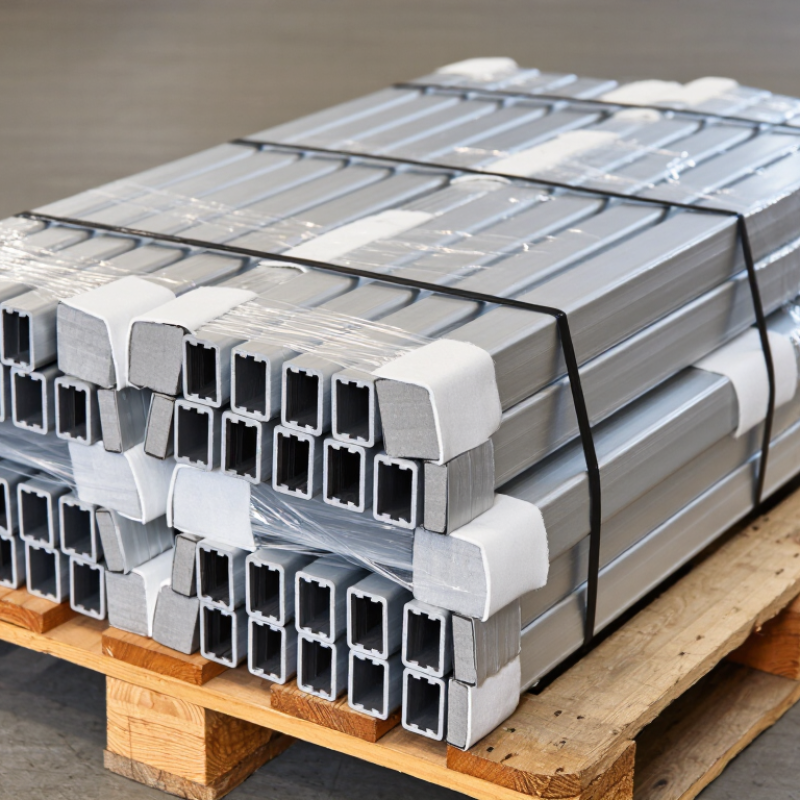
Global buyers judge an aluminum profile before they inspect its technical data. They notice the pallet first: clean wrapping, straight bundles, protected corners, and readable identification. Strong Profile Packaging reduces scratches, bending, moisture exposure, and confusion during long-distance handling. It also shows whether a supplier understands real distribution conditions.
Walter Soroka, a respected packaging author and educator, defines packaging as “the science, art, and technology of enclosing and protecting products.” That idea fits Profile Packaging well. Protection is essential, but presentation also matters. A buyer wants bundles that open efficiently, labels that match the packing list, and materials that suit warehouse handling. Clear product codes, alloy details, lengths, quantities, and batch references can prevent costly mistakes. Simple details build confidence.
This guide, “7 Profile Packaging Tips for Global Buyers,” examines practical methods for export-ready presentation. It considers edge protection, moisture control, bundle stability, pallet design, labeling, material selection, and inspection records. These choices should reflect the product and its route. A coastal shipment may need stronger moisture protection. A narrow warehouse may require different bundle dimensions. Small errors become expensive overseas.
No packaging plan is perfect. We may overprotect some profiles or underestimate unusual handling. That is why feedback, trial shipments, and documented inspections remain valuable. Good suppliers review damaged corners, loose straps, and unclear labels instead of hiding them. Reliable Profile Packaging protects the product, supports efficient receiving, and gives global buyers evidence of professional control.
7 Profile Packaging Tips for Global Buyers
Define Your Global Buyer Profile and Market Position
A strong global buyer profile begins with observed behavior, not assumptions. In past market reviews, I compared inquiry forms, shipping questions, budget ranges, and response times. These details revealed more than age or company size. A buyer asking about pallet dimensions needs a different message from one requesting private-label packaging. Record the difference.
Our first profile was too broad. It described “international businesses” and helped almost nobody. A clearer profile names the buyer’s role, market, purchasing volume, preferred communication style, and main risk. For example, a regional distributor may value stable lead times, clear documents, and small trial orders. A growing retailer may care more about flexible quantities and shelf-ready presentation.
Positioning must match that profile. State what you do, who benefits, and why your process is dependable. Use evidence such as production experience, quality checks, sample approval steps, and documented delivery practices. Avoid claims that cannot be verified. Trust is built in small details.
Keep the profile visible.
Package each point for a specific buying situation. Use local measurements where practical, explain technical terms, and show realistic product photos. A short comparison table can clarify material, capacity, finish, and order conditions. Do not hide limitations. Buyers often remember honest boundaries longer than polished promises. Recheck the profile every quarter, because markets shift and your original assumptions may age badly.
A strong profile is often the first package an international buyer opens. Keep the identity consistent across your company name, profile image, colors, and product descriptions. Use one clear promise, such as reliable small-batch supply or precise custom production. Avoid crowded banners and vague claims. A buyer should understand your offer within ten seconds.
Language shapes trust. CSA Research reported that 76% of online shoppers prefer product information in their own language, while 40% will not buy from websites written in another language.
Translate key profile sections carefully, including materials, dimensions, lead times, and support hours. Do not rely on literal translation alone. A natural phrase can feel more professional than a perfect but awkward sentence. Add simple photos of packed cartons, labeled samples, and inspection steps. These details make your process visible.
Proof should support the identity. Include measurable production capacity, response time, quality checks, and relevant certifications when available. The 2024 Edelman Trust Barometer found that business remains more trusted than government in many markets, but trust still depends on credible evidence.
That evidence must be specific. “High quality” is weak. “Each batch receives a dimensional check before dispatch” is stronger.
Review the profile with buyers from different regions. Some wording may still confuse them. That is not failure; it is useful feedback. A clear identity is built through correction, not decoration.
7 Profile Packaging Tips for Global Buyers
Present Products with Accurate and Localized Information
A global buyer judges your product profile before requesting a sample. Make every detail easy to verify. Show the product name, materials, dimensions, weight, and packaging units clearly. Use both metric and commonly requested local measurements when practical. Small errors create expensive delays.
Localize the information, not only the language. Translate technical terms through a qualified reviewer who understands the product. Adapt dates, currencies, decimal marks, and shipping terms for each market. Use clear product images with readable labels and realistic scale. Include lead times, minimum order quantities, storage conditions, and available documents. Keep these details consistent across every page.
Be precise with performance claims. Explain the test method, test date, and applicable standard when relevant. Never imply approval that has not been confirmed. Destination rules can change, so verify current labeling and import requirements before publishing. This is often missed. Add a direct contact method and state the expected response time. Buyers value accountability.
Review the profile with someone unfamiliar with the product. Ask them to find the material, unit price basis, and delivery estimate. If they hesitate, revise the layout. I have seen attractive profiles lose trust because one carton count differed from the quotation. Perfect packaging is unlikely. Honest corrections are more credible than polished confusion.
Present products with accurate, localized information across the key content areas buyers review before making contact.
A complete global product profile should combine clear specifications, localized measurements, transparent pricing, delivery information, compliance details, and accurate visual content. Treat each category as a required quality check before publishing.
Benchmark scale: percentage of required information fields completed in a product profile.
Global buyers often judge product quality before opening the carton. Your packaging becomes the first sales conversation. Clean visuals, accurate details, and consistent colors can create confidence across language barriers. A strong package should show what the product is, how it is used, and why it deserves attention.
Tip 1: Use clear product images with natural lighting. Avoid crowded backgrounds and exaggerated effects. Tip 2: Keep the front panel simple. Show the product name, main benefit, quantity, and essential handling information. Tip 3: Use readable typography. Tiny text may look elegant, but it frustrates buyers checking samples quickly. Tip 4: Match colors across cartons, labels, and product inserts. Small differences can suggest weak quality control.
Tip 5: Add visual proof where appropriate, such as material close-ups, measurement diagrams, or usage illustrations. These details help professional buyers assess consistency. Tip 6: Design for safe handling. Strong corners, suitable cushioning, and visible orientation marks protect the product during long transport. Tip 7: Review every symbol and translation with local specialists. A familiar image in one market may confuse customers elsewhere. Even experienced teams miss details sometimes. That is worth admitting. A package may look polished on screen but fail under warehouse lighting. Test printed samples, photograph them, and ask independent buyers what they notice first. Their answers often reveal trust problems before a shipment leaves the factory.
| Tip | Visual Packaging Action | Quality and Trust Signal | Practical Execution Guide | Global Buyer Consideration | Relevant Reference |
|---|---|---|---|---|---|
| 1. Create a clear visual hierarchy | Place the product name, key specification, quantity, and handling information in a consistent reading order. | A well-structured front panel helps buyers identify the product quickly and suggests organized production processes. | Use one primary product title, no more than three prominent supporting claims, and consistent spacing across all package panels. | Keep essential information understandable even when the package is viewed in a catalog image, warehouse, or trade-show display. | ISO 780: packaging handling and storage symbols |
| 2. Use accurate product photography | Show the actual package structure, materials, closure, labels, and included components rather than relying only on decorative graphics. | Consistent, realistic images reduce uncertainty and demonstrate that the supplier has a controlled, repeatable presentation. | Use front, side, back, open-package, detail, and scale-reference images; identify any computer-generated or retouched visuals. | Avoid visual claims that could be misleading in markets with strict advertising, labeling, or consumer-protection rules. | General product-information accuracy principles |
| 3. Make specifications easy to verify | Use a compact specification panel with dimensions, net or gross weight, materials, model code, and pack quantity. | Precise, visible data communicates technical competence and makes quotation, inspection, and replenishment easier. | Use consistent units, such as mm and kg, and include conversion information only when required by the target market. | Use decimal separators, date formats, and measurement units that are clear to the intended destination market. | ISO 80000 measurement and quantity conventions |
| 4. Display traceability information | Reserve a clean, scannable area for the lot number, production date, expiry date where applicable, and product identification code. | Traceability marks show that products can be checked, rotated, investigated, and recalled when necessary. | Use high-contrast printing, a defined data format, and a verification step during final packaging inspection. | Confirm destination-specific requirements for date marking, batch identification, and machine-readable codes. | GS1 identification and barcode principles; destination-market labeling rules |
| 5. Communicate material responsibility | Show the packaging material composition and relevant disposal or recycling instructions using verified symbols and plain language. | Specific material information is more credible than broad claims such as “eco-friendly” or “green.” | Identify the main material layers, avoid unsupported environmental claims, and keep certification marks separate from unverified claims. | Recycling systems and environmental labeling rules differ by country; verify local requirements before printing. | ISO 14021 environmental claims; local recycling-label requirements |
| 6. Use standardized handling icons | Use familiar symbols for fragile contents, moisture protection, orientation, stacking limits, or temperature sensitivity where relevant. | Recognizable icons reduce handling errors and demonstrate attention to logistics risk. | Place symbols on visible sides, maintain sufficient contrast, and ensure the printed icons match the actual handling requirements. | Use internationally recognized symbols and add short text when a symbol could be misunderstood in the destination market. | ISO 780 and ISO 7000 graphical symbols |
| 7. Prove protection and consistency | Show secure closures, edge protection, cushioning, tamper evidence, and carton stacking or pallet patterns in visual materials. | Visible protection features reassure buyers that the product is designed for international transport, storage, and repeated handling. | Document packaging dimensions, gross weight, pallet configuration, inspection points, and any transit-test results that apply to the product. | For wood packaging materials, confirm compliance with destination-country import rules; for regulated goods, use the applicable transport standard. | ISTA transport-test procedures; ISPM 15 for regulated wood packaging; UN transport rules where applicable |
Note: Packaging symbols, labeling, recycling claims, product safety information, and transport requirements should be verified against the regulations of each destination market before production.
Global buyers read more than your services. They read your cultural awareness. Adapt your profile to the market, not merely translate each sentence. Use local spelling, familiar date formats, and the correct currency. A buyer in Germany may expect precise specifications, while a buyer in Brazil may respond better to warmer introductions. These preferences are not fixed rules, but they affect trust.
Show practical evidence. Mention response hours with the relevant time zone. Explain delivery regions, communication languages, and standard measurement units. Use a professional photograph and images that reflect the buyer’s business context. Avoid jokes, idioms, and colors that may carry unexpected meanings. Keep claims measurable, such as “replied within one business day” instead of “always available.” Verified qualifications, clear service terms, and recent work samples strengthen credibility.
I once used a friendly phrase that sounded natural in English but felt too casual to a formal audience. That mistake taught me to review every profile with a local reader. A second review is valuable. Ask someone from the target region to check tone, symbols, and hidden assumptions. Do not pretend to understand every culture perfectly. State what you know, explain what you can provide, and leave uncertain promises out. Small details matter.
It should explain your products, capabilities, and main promise within ten seconds. Keep names, colors, images, and descriptions consistent. Avoid crowded banners and vague claims.
Show materials, dimensions, weight, packaging units, minimum order quantities, and lead times. Include metric measurements and common local units when useful. One wrong carton count can create costly confusion.
Use a qualified reviewer who understands the product. Translate technical terms naturally, not word by word. Check dates, currencies, decimal marks, and shipping terms.
Use measurable details. Mention production capacity, response time, inspection steps, and relevant documents. “Each batch receives a dimensional check” is stronger than “high quality.”
Explain the test method, test date, and applicable standard when relevant. Do not suggest approval that remains unconfirmed. Verify current destination requirements before publishing.
Show packed cartons, labeled samples, realistic product scale, and inspection activities. Use readable labels. A clean photo can reveal more than a decorative graphic.
Adapt spelling, date formats, currencies, time zones, and measurement units. State delivery regions and communication languages. Preferences vary, so avoid treating one cultural style as universal.
Ask a local reader to review wording, colors, symbols, and hidden assumptions. Avoid jokes and idioms. A phrase that sounds friendly may feel too casual elsewhere.
Provide a clear contact method and expected response time. Mention support hours with the relevant time zone. Measurable promises are safer than “always available.”
Ask someone unfamiliar with the product to locate the material, price basis, and delivery estimate. Watch where they hesitate. Attractive layouts still fail sometimes.
Profile Packaging is a strategic way to present your business and products to global buyers with clarity, consistency, and credibility. Start by defining your ideal international buyer, target markets, and unique market position. Then build a clear brand identity that communicates your values and product strengths across different languages and regions. Your profile should include accurate, easy-to-understand, and localized product information, including specifications, materials, usage details, and packaging options. Clear communication helps buyers make confident decisions and reduces misunderstandings during the purchasing process.
Visual presentation also plays an important role in building trust. Use professional images, organized layouts, and consistent design elements to communicate quality and reliability. At the same time, adapt your profile to cultural and regional expectations, such as preferred colors, symbols, communication styles, and information formats. By combining accurate content, appealing visuals, and thoughtful localization, Profile Packaging can help your business create stronger connections, improve buyer confidence, and present a professional image in diverse international markets.

ESD-PAC VINA